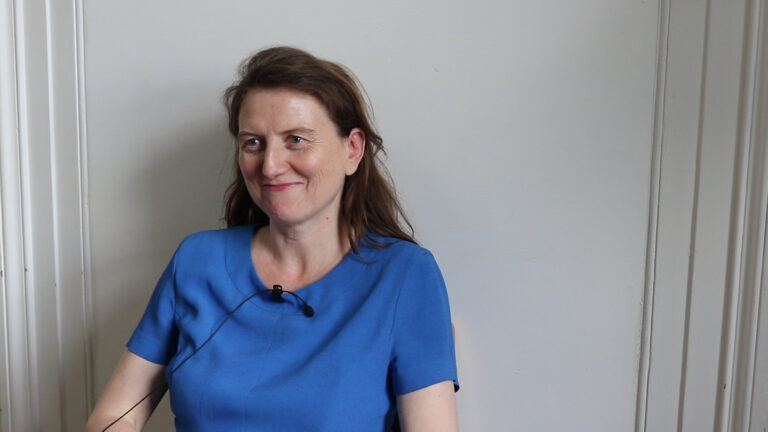
Meet Claudia and Anna. Explore how they describe the people in their lives.
Follow-up practice for Lektion 3: Familie. Complete the main lesson first, then explore these new readings and listening tasks.
01 / READ & LISTEN
Two ways to describe family.
Read each account for its main idea first. Then look for who belongs to each family and where they live.
Claudia David
Eine sehr interessante Familie habe ich. Meine Mutter ist Ägypterin und mein Vater ist Palästinenser—da fängt der Spaß an! Obwohl sie die gleiche Sprache haben, Arabisch, ist der Dialekt anders. Ich habe drei Geschwister. Sie sind alle verheiratet und ich habe viele Nichten und Neffen. Sie haben mich eine stolze Tante gemacht! Wir sind super divers—eine Mischung haben wir in unserer Familie. Es gibt Leute aus Österreich, es gibt Leute aus Syrien, aus Ägypten, und die Kinder sind teilweise in Österreich geboren, andere sind in Deutschland geboren. Wir haben deutsche Kinder und österreichische Kinder, auch von der Nationalität her. Ein Bruder von mir hat zwei Töchter, die eine ist Österreicherin, die andere ist Deutsche. Ein Teil von der Familie wohnt in Wien—in Österreich—und ein Teil wohnt in Deutschland.
Ich selbst habe keine Kinder, aber ich habe sehr viele Freunde. Also meine Freunde sind meine konstante Familie. Einer meiner Ex-Freunde, mit dem ich 11 Jahre zusammen war, ist neu liiert, und mit seiner neuen Partnerin ist er 12 Jahre zusammen. Sie haben zusammen ein Kind. Die Tochter ist jetzt 11. Wir feiern immer gemeinsam Ostern und manchmal auch Weihnachten. Das ist auch eine Familie für mich. Wir sind befreundet und wir verstehen uns auch gut.
Anna’s audio was not included in the supplied files. Use the reading for the questions below.
02 / LISTENING PRACTICE
Listen for family connections.
Watch the video, note any family words you recognise, then replay to check. Write down one phrase you would like to use yourself.
The video requires internet. Open it separately if the player does not load.
Answer from the readings and what you learned in the main lesson. Check your answers, read the feedback, and try again.
04 / MAKE IT YOURS
Describe a family.
Write two sentences about Claudia’s or Anna’s family using haben and wohnen.
Describe your own family, chosen family, or an invented family in four sentences. Mention people, connections and where they live.
Underline your verbs and check that they match the subject. Check ein / eine / einen after haben.
Wir wohnen in Berlin. Ich habe einen Bruder und eine Schwester.
Useful words: die Eltern (parents), die Geschwister (siblings), die Großeltern (grandparents), die Nichte (niece), der Neffe (nephew), befreundet (friends with one another), verheiratet (married).