Count to 1,000, talk about your age and contact details, and learn the verb sein.
This follows Lesson 2: Zählen 1. Work through the vocabulary, culture, speaking and listening activities, then continue to the Lesson 5 extension.
01 / WORTSCHATZ
Numbers, from 20 to 1,000.
Review the numbers you already know. Then practise the numbers from 20 to 1,000. German numbers from 21 to 99 usually say the ones before the tens: ein-und-zwanzig (21).
Watch and repeat the numbers aloud. The video requires an internet connection. Open on YouTube.
Read and listen to each number
The original recordings are linked from Grenzenlos Deutsch and require internet. The saved-page ZIP did not contain the MP3 files, so playback depends on the source website.
20zwanzig
21einundzwanzig
22zweiundzwanzig
23dreiundzwanzig
24vierundzwanzig
25fünfundzwanzig
26sechsundzwanzig
27siebenundzwanzig
28achtundzwanzig
29neunundzwanzig
30dreißig
40vierzig
50fünfzig
60sechzig
70siebzig
80achtzig
90neunzig
100hundert
1,000tausend
Useful words:die Nummer and die Zahl both refer to a number; zählen means “to count.”
Arbeit mit dem Wortschatz
The source uses audio-based number quizzes. Since those exercise audio files were not included in the supplied archives, this version asks you to identify the written numbers instead.
Dialog: An der Universität
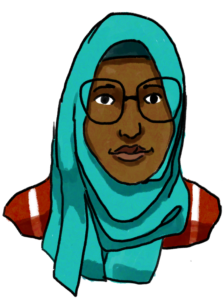
Yasmin · university dialogue
Read the exchange between a university staff member and Yasmin. Listen for her name, age, address and telephone number.
MitarbeiterIn: Wie heißen Sie?
Yasmin: Ich heiße Yasmin.
MitarbeiterIn: Wie schreibt man das?
Yasmin: Y-A-S-M-I-N.
MitarbeiterIn: Wie alt sind Sie?
Yasmin: Ich bin 21 Jahre alt.
MitarbeiterIn: Wie ist Ihre Adresse?
Yasmin: Meine Adresse ist Burggasse 34, 1070 Wien.
MitarbeiterIn: Wie ist Ihre Telefonnummer?
Yasmin: Meine Handynummer ist 0676 123 456.
MitarbeiterIn: Danke!
Yasmin: Bitte!
Try the dialogue twice: first as the staff member, then as Yasmin. Practise the formal form Sie used in the exchange.
02 / KULTUR
Addresses and telephone numbers.
Grouping numbers
In German-speaking settings, larger numbers may be spoken in groups. The postcode 1070 Wien, for example, may be read zehn-siebzig Wien. Telephone numbers may be given digit by digit or in groups of two or three.
For Yasmin’s example, practise null – sechs – sieben – sechs / eins – zwei – drei / vier – fünf – sechs, then practise the grouped version.
International calling codes
For calls to other countries, the relevant international country code is required. The lesson includes these nearby examples:
+41Switzerland
+420Czech Republic
+421Slovakia
+423Liechtenstein
+43Austria
+44United Kingdom
+45Denmark
+46Sweden
+47Norway
+48Poland
+49Germany
Accuracy update to the source: Liechtenstein’s current code is +423, not +41. The source’s old +42 note refers to the former Czechoslovak numbering arrangement.
03 / SPRECHEN
Interview: ask and answer.
Practise these questions with a classmate or answer with imaginary details. Use du in informal conversation and Sie with someone you address formally.
Wie alt bist du? / Wie alt sind Sie?Ich bin 22 Jahre alt.
In welcher Zimmernummer wohnst du?Ich wohne in Anderson Hall 305.
Wie ist deine Adresse zu Hause?Meine Adresse ist 216 Cedar Ave, Nummer 457.
04 / SCHREIBEN
Collect your interview notes.
Writing activity · original course artwork
Write the name, age, address and phone number for a few imaginary people or classmates who agree to share their details. Keep your notes for the extension’s writing activity.
Model interview notes from the original lesson
Name
Yasmin
Alter
21
Adresse
Burggasse 34, 1070 Wien
Nummer
0676 123 456
05 / HÖREN
Listen to Sabine, Susanne and Tiradard.
Watch the interviews. Focus on how the speakers introduce themselves, where they are from and how old they are. You can replay the video before answering.
The answers are drawn from the original lesson’s saved interactive questions and its age-matching task.
Sprechen: Rollenspiel
Play the interviewer and then Sabine, Susanne or Tiradard. Ask questions and answer in the first person: Wie heißen Sie? Woher kommen Sie? Wie alt sind Sie?
06 / STRUKTUREN
Das Verb sein.
Like “to be” in English, sein is irregular. Learn these present-tense forms; notice the contrast between du bist, ihr seid and Sie sind.
Present-tense conjugation of sein (“to be”)
Singular
Form
Plural / formal
Form
ich
bin
wir
sind
du
bist
ihr
seid
er / sie / es
ist
sie (they)
sind
Sie (formal)
sind
Sie (formal plural)
sind
Find the forms of sein
This text is from Claudia’s family description in the original course. Select every conjugated form of sein—and none of the other verbs.
Eine sehr interessante Familie ich. Meine Mutter Ägypterin und mein Vater Palästinenser—da fängt der Spaß an! Obwohl sie die gleiche Sprache , Arabisch, der Dialekt anders. Ich drei weitere Geschwister. Sie alle verheiratet und ich habe viele Nichten und Neffen. Sie haben mich eine stolze Tante gemacht! Wir super divers—eine Mischung haben wir in unserer Familie. Es Leute aus Österreich, es gibt Leute aus Syrien, aus Ägypten, und die Kinder teilweise in Österreich geboren, andere in Deutschland geboren. Wir deutsche Kinder und österreichische Kinder auch von der Nationalität her. Ein Bruder von mir hat zwei Töchter, die eine Österreicherin, die andere Deutsche. Ein Teil von der Familie in Wien—in Österreich—und ein Teil wohnt in Deutschland.
Schreiben
Write sentences about the ages of several family members or friends using sein. For example, Meine Mutter ist 54 Jahre alt. Now make three sentences of your own.
Free PDF study sheets to review offline. Downloads run independently of the lesson, with progress and a cancel option when supported. Every PDF also has a standard direct link.